
Why Letting Go is the Ultimate Growth Hack
The Counterintuitive Secret to Scaling Yourself and Your Team

Fear of missing out is a real thing and those of us in the tech world are no different. We might be even more susceptible actually because technology can move so fast. We’re often juggling multiple tasks, learning new things, creating things no one has seen before and the temptation to hold on to that process or strategy that has always worked, the methodology we just implemented a year ago, or to ignore or fight changes in your teams could be the thing that holds not just you back but those counting on you.
This isn’t just about juggling more things — it’s about the cost of refusing to let go. That’s where my favorite analogy comes in: the “duck of the day.”
The Duck of the Day
I don’t think there are too many people who would argue that trying to play an instrument while holding a rubber duck would be difficult. I’m not saying it can’t be done, but even a tambourine or harmonica tend to be used with two hands. Basically, the result we want would be impeded by the choice to hold on to something that doesn’t match or pair well with our goal.

And I have seen this happen time and time again in my 20+ years in technology. The “duck of the day” may change, but the need to release our grip on some of them has not. Whether it’s a legacy system that’s become a security risk, a management style that worked for smaller teams but doesn’t scale, or a pet project that’s draining resources from higher-impact initiatives - we all have our ducks.
Sometimes it’s not just one duck we’re clutching — it’s several. And that’s when the multitasking myth creeps in, making us believe we can carry it all without consequence.
The Multitasking Myth
I made a short YouTube video where I mentioned that sometimes the ducks become endangered as well, especially when multitasking gets involved. Here’s the thing about multitasking - it’s really a measure of how well you can task switch, and the costs add up quickly. In tech, we know context switching isn’t free. Every time we jump between tasks, there’s a cognitive overhead that impacts quality and speed.
As a tech leader, I was always sensitive to the cost of context switching for my team and the projects we worked on. Some days, I would literally have team members put down certain tasks so they could focus and give the attention needed to truly drive the outcomes we needed. It might mean me attending a meeting on their behalf, rescheduling a team activity, or protecting their time from “quick questions” that weren’t actually quick.

The key insight? It’s okay - actually necessary - for some things to require more focused attention. And remember, you can pick most things back up at a later date.
The same principle holds true at the leadership level. It’s not only individuals who pay the price of clutching too tightly — whole teams and organizations can stall when leaders won’t release outdated habits or processes.
Leadership Lessons in Letting Go
While I would like to believe that telling someone “what you see is what you get” is a genuine offer of transparency and openness, it can really be a pretty closed-fist approach. The way teams and people need to be led has evolved over time, and sometimes you do more harm than good by sticking to what’s always worked for you.
When I encountered this leadership style, it instantly put me in a space where I didn’t think I would be heard and shouldn’t expect very many meaningful conversations. Unfortunately, that assumption was often proven true in a short amount of time.
This resistance to change is also true when looking at systems and processes. I once worked on a system that had been built internally and, despite becoming a critical component, had grown so woefully out of date that there wasn’t even a reasonable upgrade path that wouldn’t result in noticeable and negative downtime. Several people had attempted to solve the problem but were constantly met with responses like “I don’t like the new proposal” and “we don’t have time to stop what’s working to establish something new.”
Don’t wait until you’re forced to change because of poor morale, system outages, or worse - until you keep wrecking things for people, their careers, and important projects. Unfortunately, some people and organizations never do change, even when facing these exact consequences. They just keep cycling through the same problems, losing good people, missing opportunities, and wondering why nothing ever gets better.

But letting go isn’t just a leadership challenge. It’s also a deeply personal one. I learned that lesson the hard way during my years as an engineer.
In the Trenches: Avoiding Burnout
Perhaps I’m only speaking from my experience as an engineer, but damage from not letting go can be just as detrimental to folks in the trenches every day. I always wanted to finish just one more thing, try to get ahead, push through one more feature. Turns out I was a bit of a workaholic, and I paid dearly for it. Every year, I felt like I needed at least two whole weeks just to recoup at the end of the year - and that was just to get back to baseline, not actually refreshed.
Thankfully, I learned the value of temporarily putting even the job I loved aside so I could actually be effective long-term without so many valleys. I have since learned to say no without the guilt and that self-care isn’t just a buzzword, but a needed part of being a well-balanced person and a sustainable contributor.
The best way to avoid burnout? Learn to let go before you’re forced to. Set boundaries on your “one more thing” mentality. Schedule downtime like you would any other important meeting. And remember - an ounce of prevention really is worth a pound of cure, especially when that cure might take months to recover from.
Bounce, Break, or Wait?
I once read something that basically said when juggling (tasks), you have to be able to distinguish between items you can drop because they will bounce back up, and those you can’t because they will shatter. It’s the same way when we’re deciding what to put down, what to do or not do, what to hold onto or let go of.
Some things may bounce seemingly forever - they’re resilient and can handle being set aside temporarily. Some things require both hands and your full attention to do well. Some things can be tended to by others, freeing you up for what only you can do.

Some things you’ll be able to get back to when the timing is right. Others should probably be let go of permanently. And some need better timing, more preparation, or for you or your circumstances to improve before they’re viable.
Just because something hasn’t happened yet doesn’t mean it won’t. The key is learning to recognize which category each of your commitments, projects, and priorities falls into - and having the wisdom to act accordingly.
Ask yourself: Is this something that bounces, breaks, or can wait? Does it need both hands, or can someone else handle it? Is this the right time, or should it be shelved for later?
The tech world moves fast, and holding onto everything is a recipe for burnout and stagnation. The challenge — and the opportunity — is to name your “ducky” and decide what to release so you can pick up something better.
💡 If you’d like a practical tool for this, join me on Monday, September 30th at 7p ET for a livestream where I’ll build the Strategic Letting Go Framework — a guide to help you sort your ducks once and for all.
👉 And here’s where you come in.
The framework is only useful if you’re willing to apply it.
Your Turn: What’s Your Ducky?
Whether you’re a leader clinging to outdated management styles, a developer saying yes to one more task, or an organization refusing to sunset legacy systems, remember: you can do all things, but not all things at the same time.
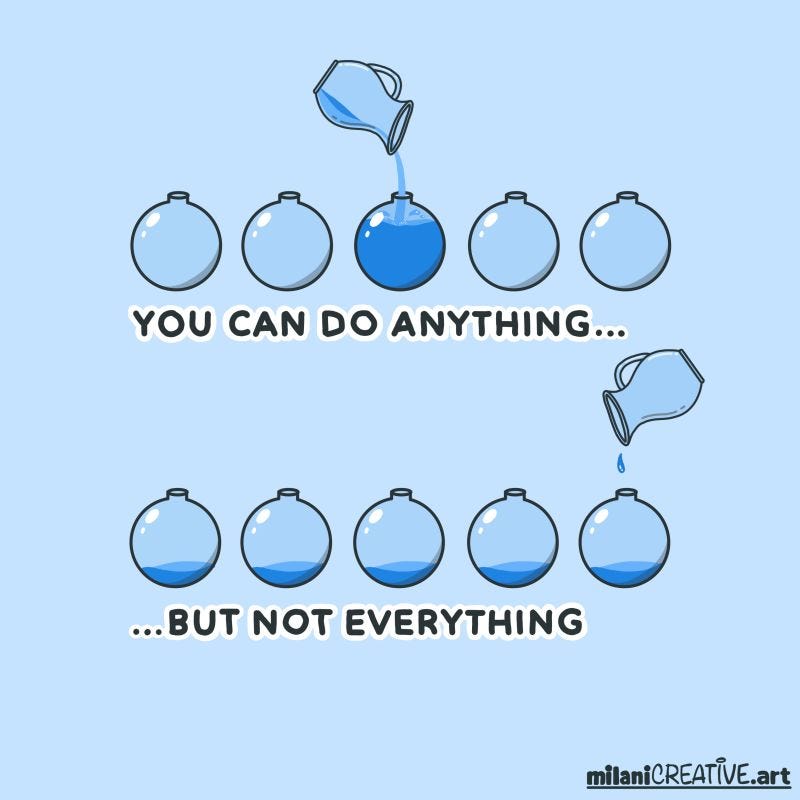
Productivity expert David Allen puts it this way: “You can do anything, but not everything.”
But honestly, Ernie from Sesame Street said it best: “Put down the ducky if you want to play the saxophone.”

Sometimes wisdom wears a suit. Sometimes it sings in a bathtub. Either way, the message is the same: you can’t hold onto everything and still move forward.
So what’s your “ducky”? What do you need to release — temporarily or permanently — to pick up something better? And what’s that saxophone you’re trying to play — that goal, skill, or achievement you’re working toward?
Drop a comment and let me know what you’re ready to let go of, or what’s been the hardest thing to release in your career. Let’s help each other grow by learning to let go.